Tests that prove what was agreed
Each user story is checked against its acceptance criteria and test cases, so a pass means what was agreed works, not that someone clicked around.
Product Quality New
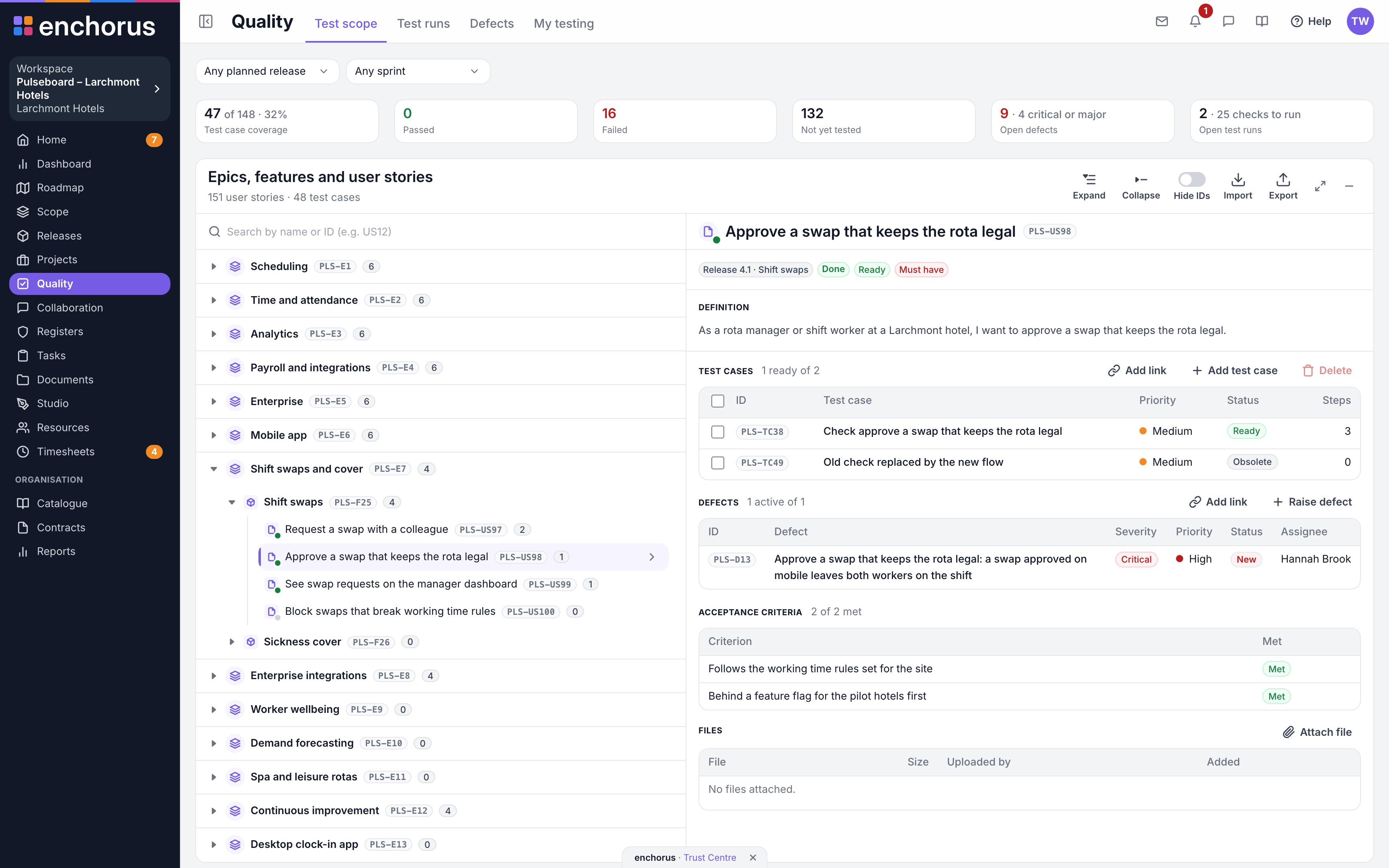
Every test traces back to a user story's acceptance criteria and forward to the defect, the fix and the retest, so sign-off rests on evidence, not opinion.
What you get
Each user story is checked against its acceptance criteria and test cases, so a pass means what was agreed works, not that someone clicked around.
A test run takes its stories from a release, a sprint or a project, and the test lead picks what to test, such as stories ready for retest or not yet tested.
A failed check becomes a defect linked to its story and its run, with nothing retyped, and moves from New to Closed one step at a time.
Planners put defects into a sprint beside its stories; once fixed, a later run retests them, and each defect shows every retest since.
A client's testers record results and raise defects with the Tester extra permission while their role stays read-only, and test planners manage tests without the rest of planning.
Release sign-off, project sign-off, test coverage and defect reports, worked out from the runs and ready for the go-live meeting.
How it holds together
Traced end to end
A defect knows the story it breaks, the run that found it, the sprint that fixed it and every retest since, and a story knows its tests and defects. Sign-off follows that chain, not someone's word.
One record
Test runs, results and defects sit with the stories, sprints and releases they belong to, so the sprint board, the release dashboard and the sign-off report all show the same picture.
The process, built in
Testers report and developers fix. A defect moves through seven steps, one at a time, and its reporter is told when it is ready for retest, so each side owns its part.
Yes. A sprint can have several test runs and a release many, each picking the stories it tests.
Yes. Give the client's testers the Tester extra permission: they record results and raise defects, while their role otherwise stays read-only.
Yes. Planners add active defects to a sprint that hasn't started or is running, and they move across its board like user stories. Unfinished defects carry on when the sprint closes.
Yes. Release sign-off and project sign-off reports show what was delivered and tested, and the test coverage and defects reports show the detail.
Yes. A defect's page shows the test run that found it and each later run's result for the same checks, marked as a retest, without changing its status for you.
Start a free trial in a minute, or book a demo and we will show you enchorus with your own projects.
14-day free trial · 3 users included · no card needed
Guides on planning, delivery and running a project office, what's new in enchorus, and offers for subscribers. Once in a while, never noise.