Scope you can hold to
The statement of work names the features it pays for, so anything outside it shows as a change, not a surprise.
Who it's for System integrators
Every implementation starts from what you have delivered before and is traced from the contract to sign-off, so the client sees risks, testing and progress as they build, not at the go-live meeting.
See enchorus with your own projects, talk through onboarding, or ask us anything, with the people who build it.
What you need
The statement of work names the features it pays for, so anything outside it shows as a change, not a surprise.
Every user story carries its acceptance criteria, test runs and defects, so done means accepted by the client.
Catalogue scope and release templates bring your proven epics, sprints, milestones and client dependencies to each new client.
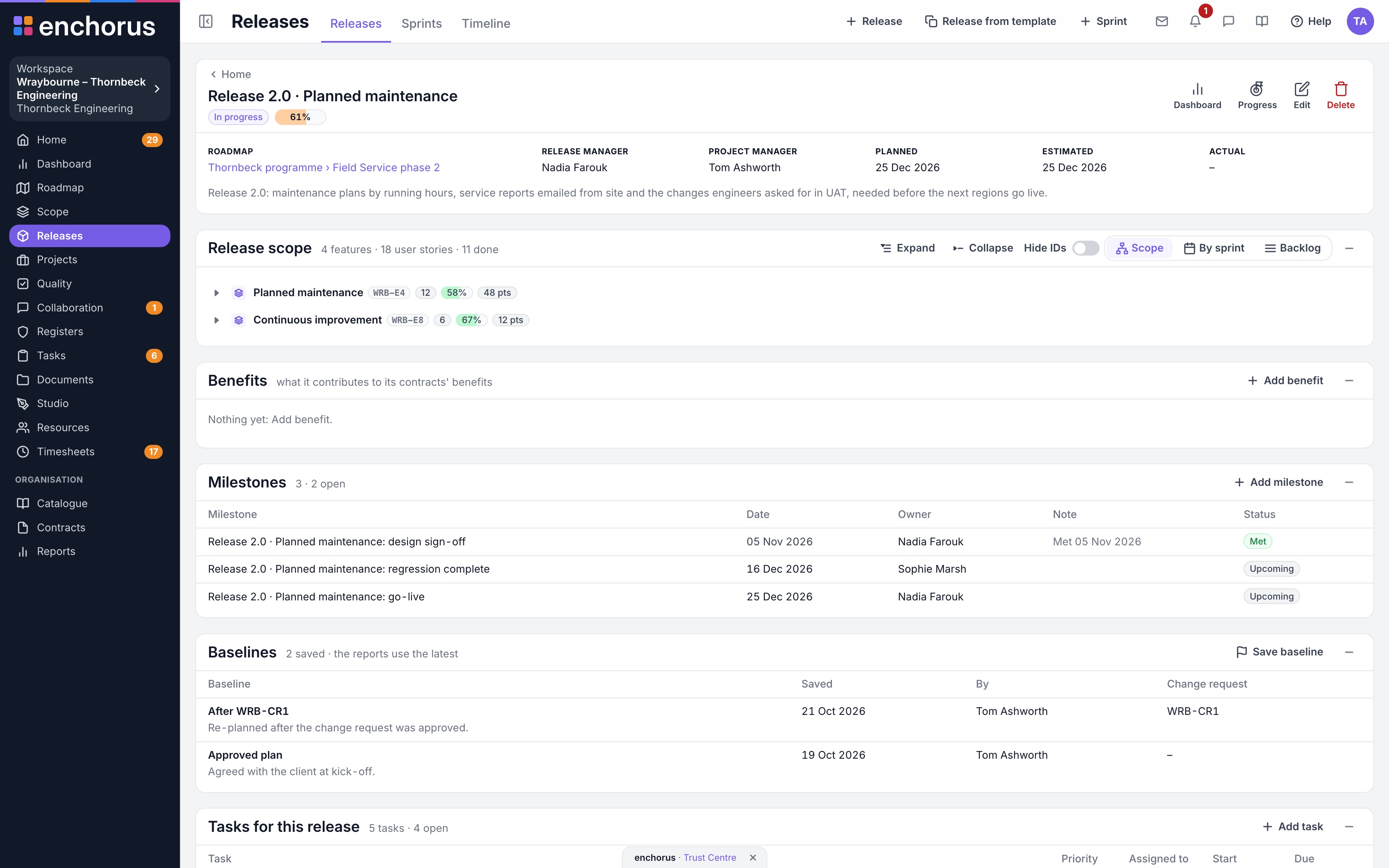
Releases made of sprints and milestones, dated from one start, with the client's dependencies due on fixed days and a baseline to measure slippage against. With AI switched on, Insights checks a client project's plan for missing steps, thin estimates and overloaded people.
Sprints, boards and burndowns for your team, and free Reader access so the client watches progress without asking for it.
Each change request records its value and hours against the statement of work, and is decided on record.
System integrators
Pull proven epics, features and stories from your catalogue into each client's scope, or draft them with AI from the client's requirement documents, and date the whole release, its sprints, milestones and client dependencies, from one start date.
A risk register and risk matrix for each release, test runs with their defects and the release sign-off report show the client how ready the go-live is, week by week.
A RASCI matrix for the release names one Accountable for every activity, and a decision log keeps what was agreed, by whom and why.
Statements of work link to the features they pay for, change requests are decided on record, and benefits are shared out to the releases that deliver them.
How it runs
The statement of work sits under the client's contract and names the features it pays for.
Proven epics, features and user stories are reviewed and pulled into the client's scope, estimates included.
A release template dates the sprints, milestones and client dependencies from one start date; the plan is saved as a baseline.
Stories move across the board against a Definition of Ready and Done, with burndown and effort for every sprint.
Test runs check each story against its acceptance criteria; the client's testers record results and raise defects.
The risk matrix, a RASCI matrix for the cut-over and the same five checks on every release show how ready the go-live is.
The release sign-off report closes the release, and its benefits are tracked against their targets.
How it holds together
Traced end to end
The statement of work holds the features it pays for, each feature its stories, each story its sprint, test runs and defects, and the release its sign-off and the benefits it realised. Any question from the client has an answer one click away.
One record
Plan, risks, tests, decisions and hours sit in the client's own workspace, so the steering pack, the sign-off report and the client's own view all show the same figures.
The process, built in
Catalogue scope, release templates with client dependencies, baselines that can't be rewritten and the same five checks on every release turn your method into how every project runs.
Yes. A catalogue holds your repeatable epics, features and user stories, pulled into a client's scope after a review, and a release template brings the sprints, milestones and client dependencies, dated from the new start.
Each release has its scope, test runs, defects and a risk register, and the client can follow them as a free Reader.
Yes. Benefits are defined with targets and shared out across the releases and projects that deliver them, with expected values and dates.
Yes. Client dependencies, such as sandbox access or sign-off, are part of a release template, each with a due day and the person on your side who chases it, and they become tasks in every release created from it.
Yes. The client's testers get the Tester extra permission to record results and raise defects against the release, while everything else stays read-only for them.
Start a free trial in a minute, or book a demo and we will show you enchorus with your own projects.
14-day free trial · 3 users included · no card needed
Guides on planning, delivery and running a project office, what's new in enchorus, and offers for subscribers. Once in a while, never noise.