A roadmap that tells the truth
Roadmap plans take their dates from the releases that deliver them, so a slipping sprint shows on the roadmap the same day.
Who it's for Software and product teams
From the roadmap to the release, every epic, feature and user story traces back to why it was built and forward to when it ships and how it was tested.
See enchorus with your own projects, talk through onboarding, or ask us anything, with the people who build it.
What you need
Roadmap plans take their dates from the releases that deliver them, so a slipping sprint shows on the roadmap the same day.
Every feature holds its user stories, each story its test results and defects, and conversations sit on the feature or story they are about.
A backlog to plan from, boards with your own stages, and burndown and effort for every sprint.
A Definition of Ready and a Definition of Done for each workspace, which warn or stop the work if you choose.
Test runs check each story against its acceptance criteria; failed checks raise defects that are fixed in sprints and retested.
Say/do, velocity and carry-over show how the team delivers, and the finish is forecast from the points left. With AI switched on, Insights explains whether a release will land, and why.
Software and product teams
Roadmap plans show the real dates of the releases that deliver them, so a slipping sprint shows on the roadmap the same day.
Every story is committed to a sprint, and every release shows its scope, its tests and its open defects.
Test runs check each story against its acceptance criteria, failed checks become defects fixed in sprints, and coverage and sign-off reports show readiness.
Delivery predictability shows say/do, velocity and carry-over, and forecasts the finish from the points left, while there is still time to cut scope or move the date.
How it runs
Roadmap plans set the direction, each linked to the release that delivers it.
The backlog breaks each epic into features and user stories, each with its acceptance criteria and estimate.
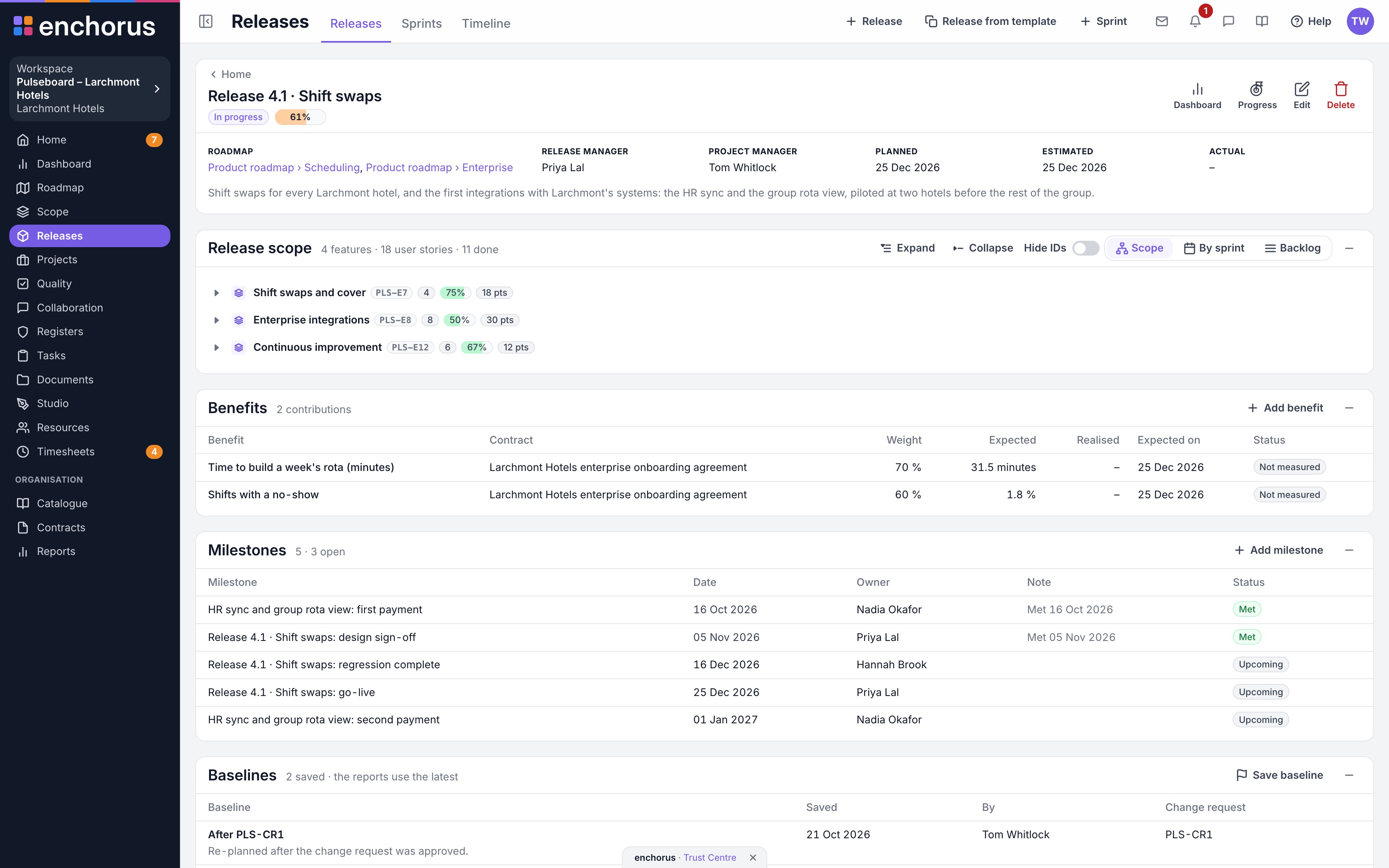
A release is made of sprints, and ready stories are committed to them from the backlog.
Stories move across the board, with burndown and effort for every sprint.
Test runs pick the stories to test; defects are raised, fixed in sprints and retested.
The release's scope, test coverage, open defects and condition show whether it is ready to go.
The release sign-off report records what shipped, and say/do and velocity shape the next plan.
How it holds together
Traced end to end
A roadmap plan links to its releases, a release to its sprints, a sprint to its stories, and each story to its feature, epic, tests and defects. Ask why something was built, or what a late story puts at risk, and the answer is one click away.
One record
Backlog, sprints, test runs, defects, hours and the roadmap live together, so the burndown, the release dashboard and the sign-off report never disagree.
The process, built in
A Definition of Ready and a Definition of Done, sprint goals, baselines that can't be rewritten and the same five checks on every release and sprint, without a coach chasing them.
Yes. enchorus covers the backlog, sprints, boards, releases, test runs and defects, and adds the roadmap, resource plans, timesheets and reporting around them, so delivery and testing live in one record.
Yes. The backlog is organised as Epic, Feature and User story, the SAFe® hierarchy, with releases made of sprints.
Yes. Readers are free and read-only, so product owners outside the team, sponsors and customers can follow progress.
Yes. A test run checks each user story of a release or sprint against its acceptance criteria and test cases, and a failed check becomes a defect linked to the story in one click.
Each user story is Draft or Ready, and a tip warns the Planners and the scrum master when a sprint starts within two days with stories that are not Ready.
SAFe is a registered trademark of Scaled Agile, Inc.; enchorus is not affiliated with or endorsed by it.
Start a free trial in a minute, or book a demo and we will show you enchorus with your own projects.
14-day free trial · 3 users included · no card needed
Guides on planning, delivery and running a project office, what's new in enchorus, and offers for subscribers. Once in a while, never noise.