Schedules you can defend
Project timelines with milestones and dependencies, saved as baselines, so slippage is measured, not argued.
Who it's for Consultancies and PMOs
Programmes, projects, risks, resources and decisions in one record across every client, from a client's requirement documents drafted into a backlog to review, to status, RAID and the margin ready the moment someone asks.
See enchorus with your own projects, talk through onboarding, or ask us anything, with the people who build it.
What you need
Project timelines with milestones and dependencies, saved as baselines, so slippage is measured, not argued.
Hours approved week by week turn into cost, margin, budget against actual and estimate at completion, for the people given the Finance permission.
Each change request records what it affects, its value and hours against the statement of work, and is decided on record.
Registers with owners and review dates, and a risk matrix of every open risk across the registers you choose. With AI switched on, Insights finds risks people have raised but nobody has recorded.
Meetings end in owned actions, and a decision log keeps each decision, its rationale and who settled it.
Project status and RAID summaries across every workspace you can open, and dashboards that cascade from the portfolio to each project.
Consultancies and PMOs
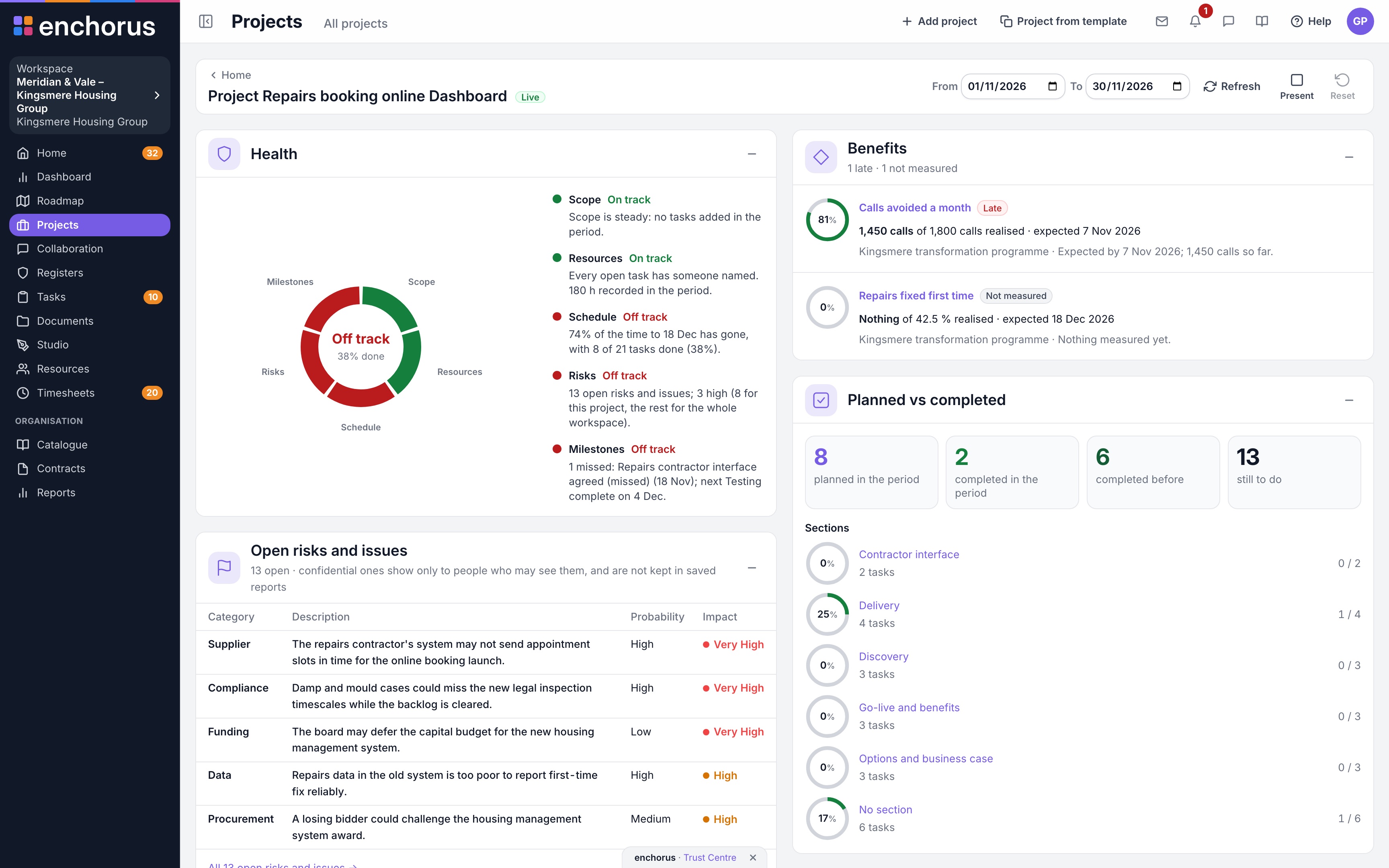
Project status and the RAID summary cover every workspace you can open, grouped by client, and dashboards cascade from the portfolio to each release and project, ready to present.
Meetings end in owned actions followed until they close, and a decision log keeps each decision, who settled it and why.
Risk registers with probability, impact and a review date, and a risk matrix of every open risk across the registers you choose.
One view shows everyone's hours in every workspace, and utilisation, realisation and estimate at completion show what the time earns, to the people given the Finance permission.
How it runs
The engagement's statement of work sits under the client's contract, with its value.
A project from a template, with sections, milestones and dependencies, saved as a baseline.
People are allocated to the project with their roles' rates and costs.
Tasks move through the plan, and hours are recorded and approved week by week.
Risks, issues and decisions are kept in registers, and every project is rated on the same five checks.
Change requests record their impact, value and hours, are decided on record, and once approved suggest a new baseline.
Status, margin and estimate at completion come from the work, and the project sign-off report closes it.
How it holds together
The process, built in
The same five checks on every release, sprint and project, baselines that can't be rewritten, review dates on every risk, a RASCI matrix with one Accountable per activity and a monthly position saved as a report.
Traced end to end
The portfolio dashboard opens each release and project, each its own dashboard, each figure worked out from the plans, registers and timesheets behind it, so every number in the steering pack can be traced to the work.
One record
Plans, RAID registers, decisions, resources and hours are kept once, across every client, so reports are current when they are opened, not when someone finishes a spreadsheet.
Yes. It brings roadmaps, projects, releases, resource plans, timesheets, risk and issue registers, meetings and dashboards into one place, so the PMO reports from the work instead of collecting updates.
Yes. Actual hours from timesheets plus each person’s estimate to complete give the forecast, compared with the allocation.
Yes. Our customer success team helps you set up your workspaces and way of working in enchorus and supports adoption, and for organisations with many teams we agree a price that includes onboarding for each team. Book a demo to talk it through.
Yes. Any workspace, release or project dashboard can be saved as a report, for example each month, so the record of how the work progressed stays with it.
The core of one. A RAID log tracks risks, assumptions, issues and dependencies. Risk and issue registers carry probability, impact, cost, mitigation and a review date; assumptions and dependencies can be kept as categories in a register, so the RAID summary report shows them; actions are followed from meeting minutes until they are closed, and decisions are kept in a decision register.
Start a free trial in a minute, or book a demo and we will show you enchorus with your own projects.
14-day free trial · 3 users included · no card needed
Guides on planning, delivery and running a project office, what's new in enchorus, and offers for subscribers. Once in a while, never noise.