Readiness before go-live
A Definition of Ready and Done for each workspace, test runs, and a condition on every release, so nothing goes live unprepared.
Who it's for In-house IT and change teams
Every team plans and delivers the same way, knowledge stays in the organisation, and every sign-in and change is on record before the auditor asks.
See enchorus with your own projects, talk through onboarding, or ask us anything, with the people who build it.
What you need
A Definition of Ready and Done for each workspace, test runs, and a condition on every release, so nothing goes live unprepared.
Each change request records what it affects, its estimated hours and its value, and is decided on record.
Probability and impact on every risk, a review date, and a risk matrix that shows which matter most.
A RASCI matrix names one Accountable for every activity, and roles keep duties apart.
The same four roles and the same release and project checks in every workspace, with shared templates and catalogues.
Every sign-in and change on record, with an activity journal for each workspace.
In-house IT and change teams
Every workspace has the same four roles, the same release and project checks, and templates and catalogues shared across the organisation, so every team plans the same way.
Conversations, decisions and documents stay with the work in the workspace, with access by role.
Every sign-in and change is on record, each workspace's admins have an activity journal by person, activity and date, and recorded hours are never deleted.
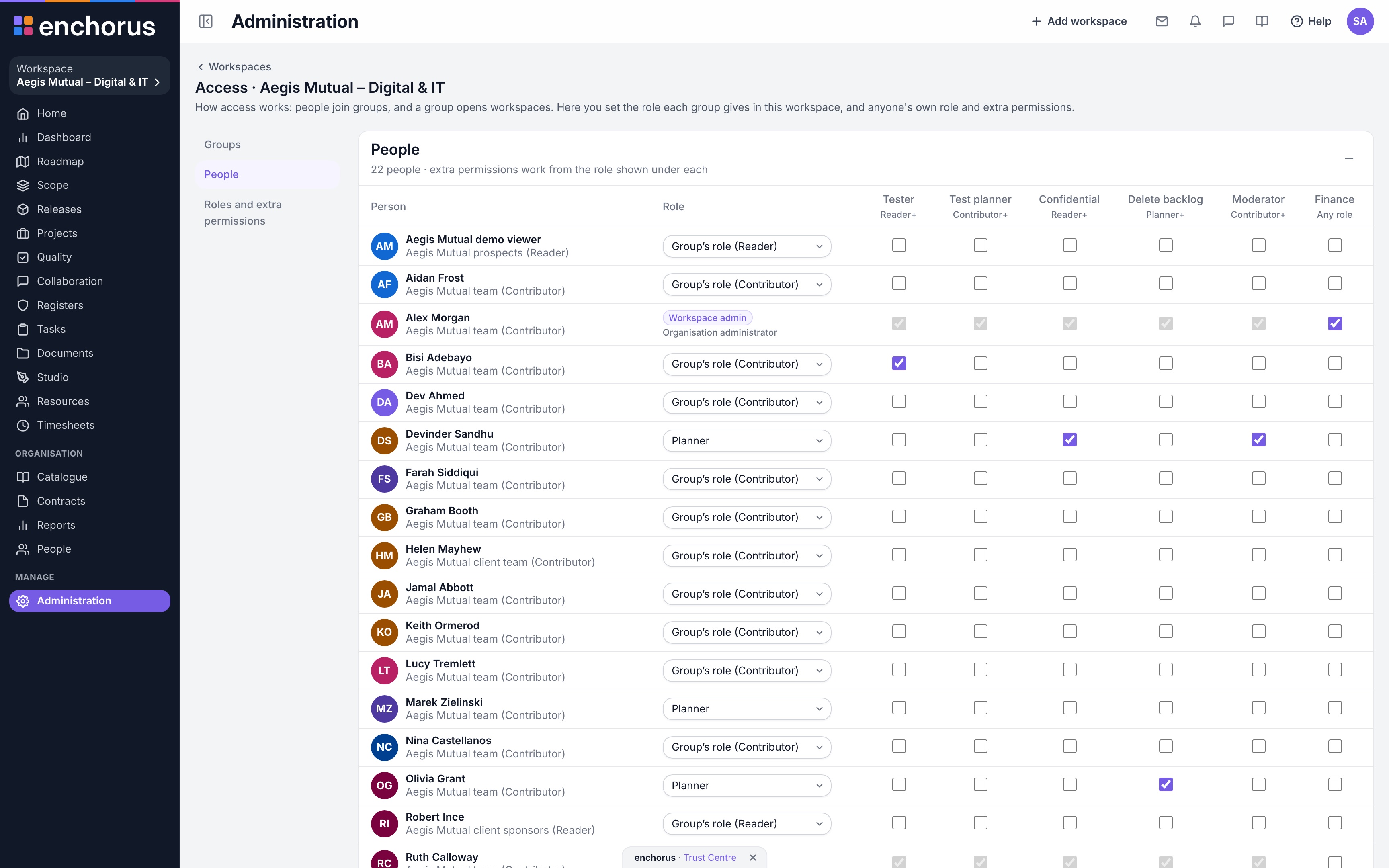
Duties stay separate: testers report and developers fix, nobody approves their own week, money only for people given the Finance permission, and AI allowed or kept out workspace by workspace.
How it runs
A change request is raised with what it affects and why.
Its impact and estimated hours are assessed, and its risks go in the register with probability and impact.
The change is approved or rejected on record, and the decision kept with its rationale.
The work is planned as a release or project, with a RASCI matrix for who does what and a baseline.
Stories meet the Definition of Ready, and test runs check the change against its acceptance criteria.
The release's condition and the same five checks show whether it is ready.
The activity journal and the record show what changed, who did it and when.
How it holds together
The process, built in
Four roles and six extra permissions, Readers always read-only, separation of duties, approved weeks locked and regular backups, enforced on the server.
Traced end to end
Every sign-in and change is logged and every decision kept with the work it changed, so an auditor's question, who changed what, when and why, is answered from the record, not from memory.
One record
Every team's plans, risks, decisions, documents and hours are kept in the same structure, so the organisation sees across teams without translating between tools.
Yes. Every sign-in and every change to plans, documents and settings is recorded.
Each organisation has its own separate database, never shared with another customer. Where it is hosted, how it is backed up and who we rely on are set out on our Trust Centre.
Yes. Each team gets a workspace with its own people, modules and data, managed by your own administrators.
Yes. Release and project templates and delivery catalogues belong to the whole organisation, so every team starts from the same plans and scope.
Most people start straight away. A short set-up wizard prepares a new organisation's first workspace for projects, agile delivery or both, and a tour shows each part of the screen on the first visit. An empty workspace shows administrators a Get started list of first steps, and the built-in knowledge base covers every feature.
Start a free trial in a minute, or book a demo and we will show you enchorus with your own projects.
14-day free trial · 3 users included · no card needed
Guides on planning, delivery and running a project office, what's new in enchorus, and offers for subscribers. Once in a while, never noise.